
Key Takeaways
- Size the transformer from measured or calculated demand, including starting loads and realistic future growth.
- Confirm voltage, phase, frequency, impedance, connections, grounding, cooling, and enclosure requirements before requesting quotes.
- Evaluate room conditions, ventilation, temperature, contamination, access, and noise alongside electrical capacity.
- Account for harmonics from electronic loads such as drives, UPS equipment, LED lighting, chargers, and data equipment.
- Compare energy losses, installation needs, testing, documentation, warranty support, and serviceability instead of purchase price alone.
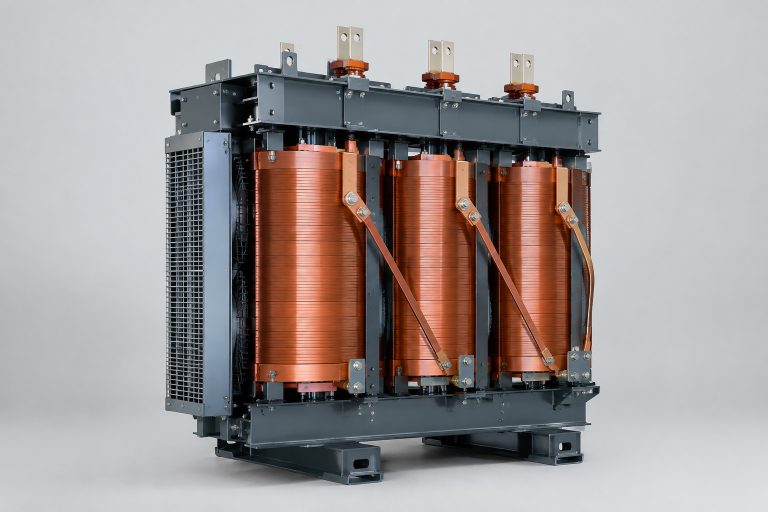
Selecting the right transformer is a design decision with long-term effects on reliability, energy use, equipment life, and future expansion. Modern facilities depend on dry type transformers to supply safe, usable voltage to panels, motors, controls, lighting, data systems, and process equipment. The best choice starts with the actual electrical system and operating environment, not simply the nearest catalog kVA rating.
Why Transformer Selection Deserves Care
A transformer that is poorly matched to its application can run hotter than expected, create objectionable noise, provide weak voltage regulation, or limit a facility’s ability to add equipment later. Underestimating environmental conditions can also shorten insulation life or complicate maintenance. A lower initial price may not represent the lowest cost over the equipment’s useful life if the unit has higher losses, requires room upgrades, or does not suit the load profile.
Commercial and industrial demand is also changing. Facilities may add automation, larger HVAC systems, production equipment, battery charging, or electric vehicle charging after the original electrical design is complete. Reviewing present demand and planned changes together helps the project team avoid both undersizing and unnecessary oversizing.
Start With the Electrical Load
Build a Clear Load List
Begin with a complete load schedule. Include motors, HVAC equipment, lighting, receptacles, controls, servers, chargers, process machinery, and downstream distribution equipment. Identify which loads run continuously, which are intermittent, and which may operate at the same time. Large motor starting current and frequent load changes deserve special attention because they can affect voltage performance.
Connected load is not the same as expected demand. A qualified electrical engineer can apply appropriate demand and diversity assumptions, review protective-device coordination, and confirm whether the transformer can support the required operating conditions. Where an existing facility has unusual equipment or recurring electrical issues, power-quality measurements can provide useful design information.
Plan for Future Demand Without Default Oversizing
Allow capacity for documented growth, such as a planned tenant improvement, additional production line, or new charging equipment. However, selecting the largest practical transformer by default is not always efficient. A unit that operates far below its intended loading can add unnecessary first cost and no-load losses. The goal is a capacity margin supported by the facility plan, rather than a guess.
Confirm the Core Electrical Specifications
A clear specification prevents suppliers from quoting materially different equipment. State the required kVA rating, primary and secondary voltage, single-phase or three-phase arrangement, and frequency. In the United States and Canada, many commercial distribution systems operate at 60 Hz, but project documents should always verify this requirement.
Also define winding connections, grounding method, tap requirements, and impedance. Impedance influences voltage regulation and the amount of fault current available on the secondary system, so it must coordinate with conductors, overcurrent protection, switchgear, and downstream equipment. Specify insulation class, temperature rise, cooling method, enclosure type, required accessories, and any sound limit applicable to the installation.
Choose the Right Dry-Type Construction
Ventilated and Encapsulated Options
Ventilated dry-type designs can be a practical choice in clean, dry electrical rooms with sufficient airflow and maintenance access. Their openings make room ventilation, dust control, and cleaning especially important. In locations exposed to moisture, dust, or contaminants, an encapsulated or cast-resin construction may be worth evaluating. The correct option depends on the manufacturer’s ratings, enclosure details, ambient conditions, and the site’s maintenance practices.
Natural-Air and Forced-Air Cooling
Natural-air cooling suits many normal applications. Forced-air cooling can support an approved higher loading arrangement or address demanding conditions, but it introduces fans, controls, noise, maintenance requirements, and a need to understand operation if fan assistance is unavailable. Do not treat fan cooling as a substitute for proper room ventilation or an appropriate base rating.
Compare the Installation Environment
Electrical capacity alone does not determine suitability. Review whether the transformer will be indoors or outdoors, how it will be delivered into place, and whether personnel will have enough clearance for inspection, cleaning, and replacement. Confirm ambient temperature, altitude, humidity, condensation risk, dust, salt air, and chemical vapors. The room must also reject the heat produced by the transformer under expected loading.
Noise deserves early attention when equipment is near offices, classrooms, healthcare spaces, or other occupied areas. The design team should also address seismic bracing where required, physical protection from impact, code-required working clearances, and enclosure ratings appropriate for the location.
Account for Harmonics and Nonlinear Loads
Many modern devices draw nonlinear current. Variable frequency drives, UPS systems, LED drivers, switched-mode power supplies, battery chargers, data equipment, and EV charging equipment can contribute harmonic current. Harmonics can increase heating in transformer windings and neutral conductors, so a conventional selection based solely on fundamental load may not be enough.
Ask for a power-quality review when the facility has substantial electronic loads, sensitive equipment, or known distortion concerns. Depending on the results, the engineer may specify a K-factor-rated transformer, harmonic-mitigating design, a suitable neutral arrangement, or other system-level measures. The right response depends on the measured or anticipated load spectrum, not on a label alone.
Review Efficiency and Compliance Requirements
Compare no-load losses and load losses at the expected operating point, not only at nameplate capacity. In the United States, covered distribution transformers are subject to federal energy-conservation requirements, and the amended federal standards require compliance on and after April 23, 2029. Confirm whether the proposed equipment falls within the covered category and whether the project’s manufacturing, delivery, and commissioning schedule crosses that date.
Project teams should also verify local code requirements, utility requirements, authority-having-jurisdiction expectations, certifications, markings, test reports, and required installation clearances. For Canadian projects, Canadian dry-type transformer requirements should be reviewed before finalizing the purchase specification.
Use a Practical Total-Cost Comparison
- Compare purchase price, freight, rigging, installation labor, and any electrical-room modifications.
- Review expected no-load and load losses over the planned operating profile.
- Include cleaning, inspection, fan service, spare parts, and access requirements.
- Match warranties, factory testing, drawings, manuals, and technical support.
- Consider the operational consequence of an outage or inadequate future capacity.
A fair quote comparison requires equivalent ratings, enclosure details, accessories, testing, lead times, and documentation. A low quote with omitted monitoring, different impedance, reduced environmental protection, or incomplete test requirements is not directly comparable to a complete specification.
Prepare a Better Transformer RFQ
Include the project location, installation type, kVA rating, primary and secondary voltage, phase, frequency, connections, grounding, impedance range, insulation class, temperature rise, cooling method, enclosure, ambient temperature, altitude, sound limit, harmonic requirements, accessories, factory tests, documentation, delivery constraints, and commissioning needs. Include site access details so suppliers can identify shipping, lifting, and placement considerations early.
Common Selection Mistakes to Avoid
- Selecting from connected load alone without considering demand, motor starts, and simultaneous operation.
- Ignoring room heat, ventilation, service clearance, or site contamination.
- Leaving harmonics and neutral loading out of the design review.
- Assuming future expansion without defining a realistic growth plan.
- Comparing quotes that differ in impedance, accessories, tests, delivery terms, or warranty coverage.
Conclusion
The right dry-type transformer reflects the facility’s load, voltage system, environment, maintenance capability, and expansion plan. By documenting those conditions before procurement, owners and project teams can request comparable quotations, reduce installation surprises, and select equipment that supports dependable operation over the long term.