
Post Preview
Key Takeaways
- Mobbin gives AI agents access to real product screens and flows, helping teams ground design decisions in observable interface patterns.
- A practical MCP stack separates reference sources, internal systems, and action-oriented tools.
- Mobbin fits the reference layer, while design systems, repositories, and workflow tools provide constraints and execution paths.
- Strong implementation depends on clear permissions, focused server responsibilities, and human review for consequential actions.
How Can Mobbin Help AI Agents Make Better Product Decisions?
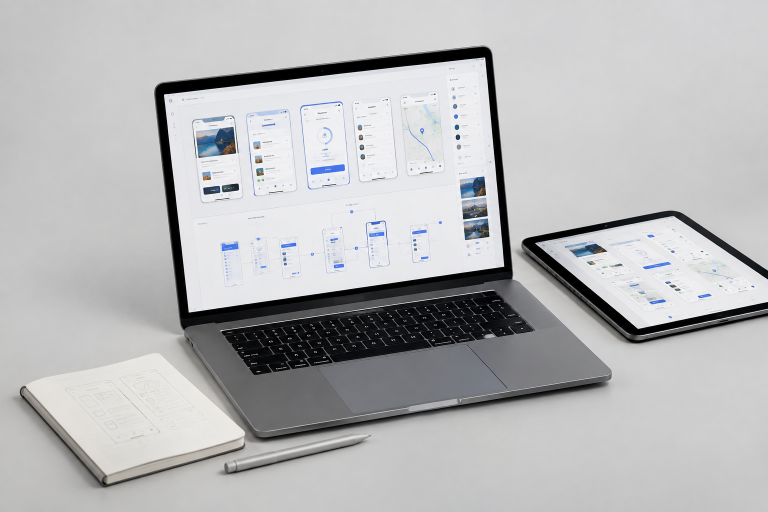
AI agents can quickly create drafts, code, and interface suggestions, but a short prompt rarely provides them with enough product context to make consistently thoughtful design choices. Mobbin helps close that gap by bringing real app screens, user flows, and interaction patterns into the AI workflow via MCP examples relevant to the task at hand.
For example, a team creating a mobile subscription flow can ask its agent to identify common approaches to paywall placement, plan comparison, trial messaging, and confirmation states. With Mobbin available as a design reference, the agent can pull relevant real-world screens into the conversation, identify recurring patterns, and turn those observations into a more precise brief for the team. The result is not a copied interface. It is a better-informed starting point for product and design judgment.
What Is MCP, and Where Does Mobbin Fit?
Model Context Protocol, or MCP, is a standard for connecting AI applications to external sources of context and capability. In a typical setup, a host application manages connections to servers, while each server exposes focused resources, prompts, or tools for the AI workflow. The protocol's server primitives distinguish between contextual resources, reusable prompts, and executable tools.
In simple terms, the AI client is where a person works with the agent. The server is the connected service that can provide information or complete a defined task. Mobbin serves as a design-focused source of external product references, enabling an agent to research patterns before recommending, designing, or implementing an interface.
Concrete MCP Server Examples for Product Teams
Although MCP itself does not require servers to fit into fixed business categories, product teams can use three useful groups to design a safer, clearer workflow: reference servers, system servers, and action servers.
Reference Servers: Evidence for Better Decisions
Reference servers give an agent material to inspect, compare, and summarize. Their primary purpose is to improve the quality of context before work begins.
- Mobbin: Mobbin is a reference solution for searching real product screens, flows, and design patterns. It helps agents study how existing digital products approach problems such as onboarding, navigation, checkout, dashboards, and empty states.
- Product documentation: Internal guides, research notes, and approved specifications can provide an agent with factual context on goals and requirements.
- Knowledge bases: A curated company knowledge source can provide terminology, policies, and prior decisions.
Mobbin is especially valuable in this layer because it provides visual and flow-level evidence. Instead of asking an agent to imagine every interface decision from scratch, a team can ask it to identify patterns across relevant shipped experiences.
System Servers: Internal Rules and Constraints
System servers connect the agent to the rules that make a recommendation appropriate for a specific organization and product.
- Design system servers: These can expose approved components, tokens, typography, spacing guidance, and accessibility requirements.
- Design file servers: Connections to current design files can help an agent understand the work already in progress.
- Repository servers: Codebases, issue context, and implementation conventions can define what is technically practical.
- Mobbin's role: Mobbin complements these internal systems by supplying external references. It can help an agent answer what patterns users may already recognize, while internal systems answer what the team is permitted to build.
Action Servers: Moving From Insight to Delivery
Action servers enable bounded, observable work after the research and constraints are understood.
- Browser and testing servers: These can inspect rendered interfaces, run checks, or support validation workflows.
- Issue-tracking servers: These can create a ticket or update a task after a team approves the plan.
- Repository and deployment servers: These can support controlled changes to code and delivery processes.
- Mobbin's role: Mobbin strengthens action-oriented work by helping the agent produce a clearer design rationale before creating a task, changing code, or evaluating a result.
Useful MCP Examples for Designers and Developers
- Improve onboarding: Research welcome screens, permission requests, progressive disclosure, and first-use guidance before defining a new flow. With MCP examples, an AI agent connected to Mobbin can pull real onboarding screens from leading apps, identify how they handle permission requests and progressive disclosure, and synthesize those patterns into a more thoughtful starting point for your team's flow.
- Plan a dashboard: Compare information hierarchy, navigation, filters, cards, and data-density choices across relevant products.
- Review an empty state: Examine how other products explain the situation, offer a next step, and help users recover.
- Prepare a checkout experience: Study address entry, payment selection, order review, and confirmation patterns before implementation.
- Support design critique: Use a focused set of references to discuss tradeoffs with more specificity than a purely subjective review allows.
How Should Teams Implement an MCP Stack?
Start with narrow responsibilities. A reference server should provide useful evidence without being given unnecessary access to internal systems. A design-system connection should expose approved rules. An action-oriented connection should perform only the tasks it has been authorized to perform.
Teams should also make tool descriptions clear, separate read-only access from write access, and require approval before actions that alter code, tickets, customer data, or production systems. MCP supports capability-based connections, but safe implementation still depends on deliberate permissions and review practices.
Why Mobbin Is a Strong Reference Layer for AI-Assisted Design
Mobbin helps teams use AI for a common product task: finding relevant examples before deciding what to build. It does not replace user research, accessibility review, brand strategy, or the team's design system. Instead, it provides the agent with more useful visual context, allowing recommendations to be tested against recognizable patterns rather than generated from a vague request alone.
The strongest workflow combines evidence, constraints, and execution. Mobbin can inform the design direction, internal systems can keep the work aligned with the product, and action tools can help the team deliver and validate the approved result. That combination makes AI assistance more practical, traceable, and grounded in the realities of product work. By leveraging MCP examples throughout your workflow and understanding how MCP examples fit into your broader stack, you position your team to make smarter, faster product decisions.