
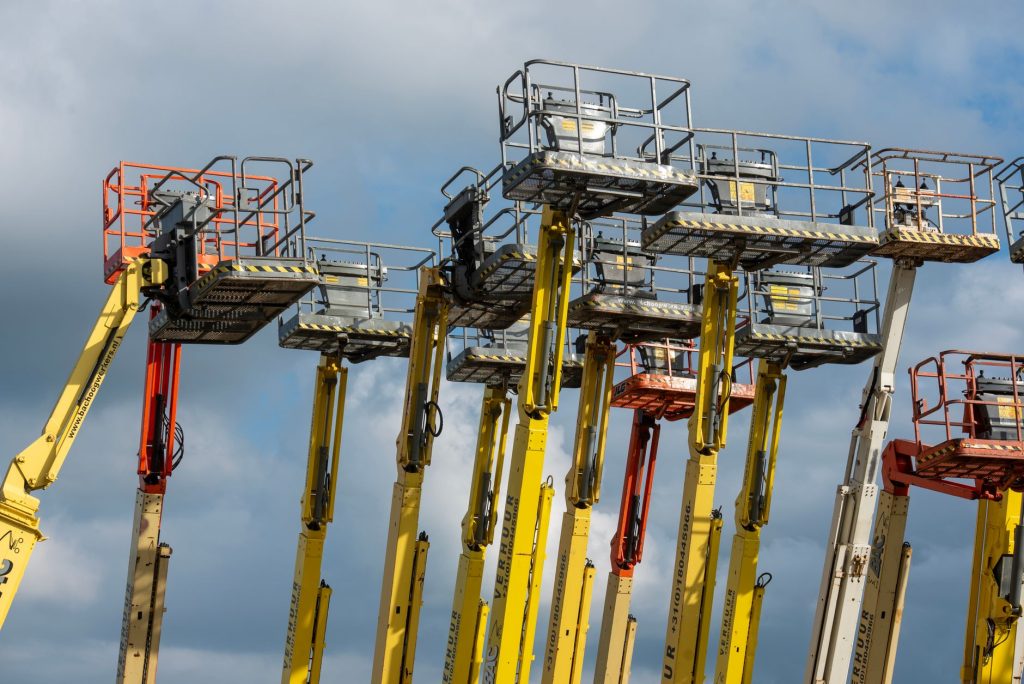
Working safely at height often requires more than a ladder or basic scaffolding. Construction companies, maintenance teams, warehouse operators and facility managers frequently rely on powered access equipment to reach elevated work areas efficiently. Two of the most common options are boom lifts and scissor lifts.
Although both machines provide a stable working platform, they are designed for different environments and tasks. Choosing the right lift can improve productivity, reduce equipment hire costs and help workers complete elevated jobs more safely.
Understanding Boom Lifts
A boom lift uses a hydraulic arm to raise and position a work platform. Depending on the model, the arm may extend vertically, horizontally or around obstacles. This makes a boom lift particularly useful when workers cannot position the machine directly below the work area.
There are two main types of boom lift. Telescopic boom lifts use a straight arm that extends outward, providing significant horizontal and vertical reach. Articulating boom lifts have jointed arms that can bend around structures, machinery, trees and other obstructions.
Boom lifts are commonly used for building maintenance, electrical work, roofing, painting, signage installation and construction projects. Outdoor models may include four-wheel drive, heavy-duty tyres and stabilising systems that allow them to operate on rough or uneven ground.
Understanding Scissor Lifts
A scissor lift raises its platform vertically using a folding support system arranged in a criss-cross pattern. As the supports open, the platform moves straight upward. Unlike a boom lift, a scissor lift generally provides little or no horizontal reach.
The main advantage of a scissor lift is its large platform. It can often accommodate several workers, tools and materials at the same time. This makes it practical for jobs that require people to work across a broad elevated area rather than reaching one specific point.
Electric scissor lifts are commonly used indoors in warehouses, shopping centres, factories and commercial buildings. Rough-terrain scissor lifts are designed for outdoor construction sites and may offer greater platform capacity, larger tyres and stronger lifting systems.
Consider the Required Reach
Reach is one of the most important factors when choosing between the two machines. A scissor lift is suitable when workers can position the equipment directly underneath the work area and only need to travel vertically.
A boom lift is generally the better option when the job requires horizontal outreach. For example, a worker repairing an exterior wall may need to reach over landscaping, fencing or another section of the building. An articulating boom lift can move the platform around these obstacles without requiring the machine to sit immediately below the work location.
Height requirements also matter. Both types of equipment are available in different sizes, but boom lifts often provide greater working heights for major construction and industrial projects.
Evaluate the Work Environment
The conditions at the job site will influence which lift is most practical. Indoor projects often favour electric scissor lifts because they are compact, quiet and produce no exhaust emissions while operating. Their tight turning circles can also make them easier to manoeuvre through warehouse aisles or commercial spaces.
Boom lifts are often better suited to sites where access is restricted or the ground layout prevents straightforward positioning. Rough-terrain models can travel across construction areas, gravel, compacted soil and other challenging surfaces.
Before selecting any access equipment, assess floor strength, doorway clearance, overhead hazards, ground stability and the amount of space available for manoeuvring. A machine that offers excellent reach may still be unsuitable if it cannot enter or safely operate within the work area.
Compare Platform Size and Capacity
Scissor lifts usually provide larger platforms and higher load capacities than boom lifts. This allows workers to carry equipment, tools and building materials without repeatedly lowering the platform.
A boom lift platform is generally smaller because the machine is designed to position one or two workers at a particular location. It is ideal for focused tasks such as inspections, repairs or installations, but may be less efficient for jobs involving several workers or bulky materials.
Businesses should check the equipment’s rated platform capacity rather than estimating what it can safely carry. The total weight must include all workers, tools, materials and protective equipment.
Think About Mobility During the Job
Many modern lifts allow limited movement while the platform is raised, although this depends on the model and operating conditions. A scissor lift can be highly efficient when workers need to move gradually along a straight wall, ceiling or warehouse aisle.
A boom lift provides more flexible platform positioning, but relocating the entire machine may take longer. Its strength lies in its ability to reach difficult areas from a single position rather than transporting a large team across an extended work surface.
Making the Right Choice
A scissor lift is usually the best choice for vertical access, larger work teams and jobs requiring a spacious platform. A boom lift is more suitable when workers need greater height, horizontal reach or the ability to move around obstacles.
The final decision should also consider site conditions, load capacity, operating space and the training required to use the equipment. By matching the machine to the specific demands of the project, businesses can complete work at height more safely, efficiently and cost-effectively.